
Last updated: April 2026
Your dentist used the words “mild underbite” and now you are not sure whether to be worried or relieved. Maybe your child’s pediatrician flagged it. Maybe you noticed it yourself in a school photo. Either way, you are searching because you want one straight answer to one specific question: does a mild underbite actually need to be fixed?
The honest answer from the orthodontist’s chair is that it depends on three things: your child’s age, whether the underbite is dental or skeletal, and a handful of specific signs that tell us whether it will get better, stay the same, or get worse without treatment. Some mild underbites genuinely do not need correction. Some need to be addressed quickly. Most fall somewhere in the middle and need monitoring.
After more than a decade of evaluating bite issues at RuCo Orthodontics in Smyrna, here is how we actually think about it.
What Is a Mild Underbite?
A mild underbite is a Class III malocclusion in which the lower front teeth sit slightly in front of the upper front teeth when the mouth is closed, but the misalignment is small. In a normal bite, the upper teeth overlap the lower teeth by 1 to 2 millimeters. In a mild underbite, the relationship is reversed and the lower teeth either edge-to-edge with the upper teeth or extend just past them by a small margin.
According to the Cleveland Clinic, about 5 to 10 percent of people have an underbite of some severity, and a meaningful share of those are mild. Many people with a mild underbite have no symptoms, no functional issues, and no idea they have one until a dentist or orthodontist points it out.
The term “mild” matters because it determines almost everything about treatment. A mild underbite is rarely a candidate for jaw surgery, often correctable with braces or clear aligners alone, and sometimes does not need treatment at all. The rest of this guide is about figuring out which of those buckets your situation falls into.
Does a Mild Underbite Need Treatment?
The answer falls into one of three buckets after we evaluate a patient.
Treat now. Some mild underbites need correction quickly even though they are mild. Usually this is because the patient is in a specific age window (typically 7 to 10) where treatment is dramatically easier than it will be later, or because the underbite is causing other problems (jaw discomfort, tooth wear, speech issues). Treating early can prevent a mild underbite from becoming a moderate or severe one as the jaw finishes growing.
Monitor. Some mild underbites are stable and not causing issues, but they need regular orthodontic checkups to make sure they do not get worse. The American Association of Orthodontists recommends a first orthodontic evaluation by age 7. From that point forward, an orthodontist can track the bite over time and intervene only if it shifts. Monitoring is not “do nothing.” It is a deliberate plan.
Leave alone. A small share of mild underbites are essentially cosmetic, do not affect function, are not getting worse, and do not bother the patient. In adults especially, treating a mild underbite is sometimes optional. The honest framing here is that you have a choice, and the choice depends on what you care about (function, appearance, long-term tooth health).
The single biggest mistake we see is parents in the “monitor” bucket who do not actually monitor. They hear “it does not need treatment right now” and never come back for a follow-up. By the time the underbite has progressed, the easiest treatment window has closed. If your dentist or orthodontist tells you a mild underbite is fine for now, that is a recommendation to come back in 6 to 12 months, not a discharge.
The Age Calculus: Why When Matters as Much as What
Age is the single most important factor in deciding what to do about a mild underbite. The same condition that needs aggressive intervention in a 9-year-old might be left alone in a 35-year-old. Here is how we think about it by age tier.
Ages 6 to 9: The Golden Window
This is when treatment is dramatically easier and more effective. The upper jaw is still growing, the lower jaw can still be guided, and a relatively short course of treatment (often 9 to 12 months in this age range) can prevent a mild underbite from worsening. We use this window for Phase 1 orthodontic treatment, sometimes with a palate expander or reverse-pull facemask. Phase 2 (full braces) usually comes later, around ages 11 to 13. If a dentist flags a mild underbite at age 7, the answer is almost always to evaluate now. Our what age do kids get braces guide covers the broader timeline.
Ages 10 to 13: Still Actionable
The upper jaw is mostly done growing, but the lower jaw is still active. Mild underbites at this age are usually treatable with braces or clear aligners plus elastics, often as part of a single full treatment phase. This is the most common age range we see for underbite correction at RuCo. The treatment is straightforward, the timeline is predictable (typically 18 to 24 months), and the outcome is reliable.
Ages 14 to 17: The Window Narrows
By the mid-teens, jaw growth is finishing and the skeletal correction options shrink. A mild underbite at this age is still treatable orthodontically as long as it is dental rather than skeletal. Skeletal cases that have not been addressed earlier are harder to fully correct without surgery, but mild cases usually do not require surgery even at this age.
Adults
For adults, a mild underbite has typically stabilized and will not get significantly worse on its own. Treatment is optional and is usually done with braces or clear aligners plus elastics. Surgery is almost never needed for a true mild underbite in an adult. The decision becomes about what the patient wants: improved appearance, easier chewing, less tooth wear over the next 30 years, or simply leaving it alone.
The pattern: the older the patient, the smaller the treatment window for skeletal correction, and the more the decision becomes about preference rather than necessity.
Skeletal vs. Dental: What Type of Mild Underbite Do You Have?
This is the distinction most articles skip, and it matters because it determines treatment.
A dental underbite is caused by tooth position. The upper and lower jaws are normal in size and position, but one or more upper front teeth are tipped inward, or one or more lower front teeth are tipped outward, putting the lower teeth in front. Dental underbites are usually easier to correct because we just need to move teeth, not bones. Braces or clear aligners with elastics will typically handle this in 12 to 24 months.
A skeletal underbite is caused by jaw position. The lower jaw is slightly longer or more forward than the upper jaw, causing the lower teeth to sit ahead of the upper teeth even when the teeth themselves are positioned correctly. Skeletal underbites are harder to treat because the underlying issue is bone, not teeth. In children with growing jaws, we can sometimes guide the bones into a better relationship with appliances like reverse-pull facemasks or expanders. In adults, the skeletal component cannot be changed without surgery, but mild skeletal underbites can often be camouflaged with orthodontic treatment alone.
How an orthodontist tells the difference. A clinical exam plus a panoramic and cephalometric x-ray (a side view of the skull and jaws) lets us measure the angles and distances that distinguish dental from skeletal. We do this at every consult. You do not need to figure it out yourself.
The reason this matters: a mild dental underbite at age 14 is straightforward. A mild skeletal underbite at age 14 is more complex. They are not the same condition, even though they look similar from the outside.
Signs Your Mild Underbite Should Be Treated Now
Some mild underbites need to be addressed sooner rather than later. Watch for these:
- The underbite has gotten more pronounced over the past year. A worsening underbite is a stronger treatment indicator than a stable one of the same severity. Compare old photos to recent ones. If you see a clear difference, get evaluated.
- Speech issues, especially with “s,” “f,” “th,” or “v” sounds. A mild underbite that is affecting speech is not really mild from a functional standpoint, even if the visual appearance is subtle.
- Jaw discomfort, clicking, or popping. Bite misalignment can stress the temporomandibular joint. If your child reports jaw soreness, clicking, or pain when chewing, that is a treatment signal.
- Uneven wear on the front teeth. When the bite does not align correctly, the teeth that contact each other wear faster. If a dentist has flagged unusual wear patterns, the underbite is doing damage.
- Difficulty chewing certain foods. Cutting food with the front teeth (sandwiches, apples) becomes harder with an underbite. If your child consistently avoids using their front teeth, that is a functional sign.
- Your child is between 7 and 10. This is not a sign of severity, it is a sign of opportunity. Treatment in this window is significantly easier than later.
If any of these are present, schedule an orthodontic evaluation. Most of them, individually, are not emergencies, but together they make a strong case for treatment now rather than later.
Treatment Options for a Mild Underbite
For most mild underbites, the treatment options are straightforward. Severe cases sometimes require surgery, but mild cases almost never do.
Braces
Traditional metal braces are the most common treatment for mild underbites in teens and adults. The brackets and wires move teeth precisely, and small elastic bands (rubber bands the patient hooks between upper and lower brackets) apply the force needed to correct the bite relationship. Treatment time is typically 18 to 24 months for a mild underbite. Predictable, reliable, and the option insurance covers most consistently.
Clear Aligners
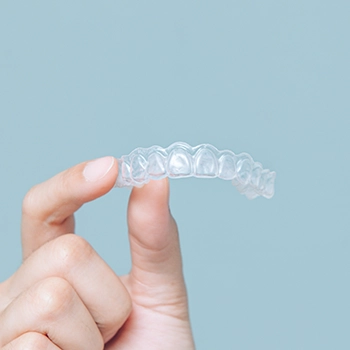
Clear aligners like Invisalign can correct mild dental underbites, especially when paired with elastics. They are nearly invisible, removable for eating and brushing, and a strong option for teens and adults who want a discreet treatment. The trade-off: aligners require 20 to 22 hours of daily wear to work, and patients who do not wear them as directed get worse results. For mild skeletal underbites, aligners are generally not the first choice. Braces handle skeletal correction more reliably.
Palate Expander (Children Only)
For mild underbites in younger children with narrow upper jaws, a palate expander widens the upper arch over a few months. This creates room for the upper teeth to move into a better relationship with the lower teeth. Expanders work because the bones of the upper jaw have not fused yet. After about age 14, this option is no longer viable.
Reverse-Pull Facemask (Children Only)
For mild skeletal underbites in children ages 6 to 10, a reverse-pull facemask gently pulls the upper jaw forward over several months. The device is worn at home and during sleep. It works only while the jaw is still growing. Used correctly, it can prevent a mild skeletal underbite from becoming a severe one.
Surgery
For a true mild underbite, jaw surgery is almost never necessary. Surgery is reserved for severe skeletal cases where orthodontic treatment alone cannot achieve a stable, functional bite. If anyone is recommending surgery for a mild underbite, get a second opinion.
Frequently Asked Questions
Will a mild underbite get worse with age?
Sometimes, especially in children whose jaws are still growing. A mild underbite at age 9 can become moderate by age 14 if the lower jaw outpaces the upper jaw during the growth spurt. In adults whose growth is complete, a mild underbite typically stays stable. This is why monitoring during childhood matters even when treatment is not started immediately.
Can a mild underbite cause TMJ problems?
It can, but it does not always. Mild underbites that put unusual stress on the jaw joint can contribute to temporomandibular joint disorders over time. If a patient with a mild underbite reports jaw clicking, popping, soreness, or headaches, the underbite is a likely contributor and treatment becomes more important. Many people with mild underbites have no TMJ symptoms at all.
Can a mild underbite be fixed without braces?
For dental cases, sometimes. Clear aligners with elastics can work for many mild dental underbites. Veneers and bonding can also visually camouflage a very mild underbite without correcting it functionally. For skeletal cases in growing children, appliances like expanders or reverse-pull facemasks can help guide jaw growth. There is no reliable way to fix a true mild underbite without some form of orthodontic treatment, however.
How long does treatment for a mild underbite take?
Most mild underbites are corrected in 12 to 24 months with braces or clear aligners. Phase 1 treatment in younger children (using expanders or facemasks) is usually 9 to 12 months, followed by Phase 2 with braces a few years later. The exact timeline depends on the age of the patient and whether the underbite is dental or skeletal.
How much does mild underbite treatment cost?
In our area, treatment for a mild underbite typically falls in the same price range as standard orthodontic treatment, usually $4,000 to $7,000 for braces or clear aligners. Most insurance plans that cover orthodontic treatment will cover mild underbite correction the same way they cover other braces cases. We walk parents through the specifics during the free consult.
The Bottom Line
A mild underbite is one of the most common conditions we evaluate, and the right answer depends on age, type, and a handful of specific signs. Some need treatment now. Some need monitoring. Some are fine to leave alone. The wrong move is guessing without an evaluation.
If your dentist has mentioned a mild underbite or you have noticed one yourself, book your free consult at RuCo Orthodontics. We will take the x-rays, do the measurements, and tell you honestly which bucket your situation falls into. No pressure. No upselling. Hablamos español.
About the Author
Dr. Anish Gala, Board-Certified Orthodontist, American Board of Orthodontics
Dr. Gala is the co-founder of RuCo Orthodontics in Smyrna, Tennessee, with more than a decade of experience treating children, teens, and adults across Rutherford County. He sees patients in the office every day, alongside Dr. Sasha Baston, and has evaluated thousands of bite issues, from mild underbites to complex Class III malocclusion cases.